Communications, Avionics and Power Architecture
AUAV-AVI-2026-01
This note describes the datalink, onboard computing and power architecture of the Atilim UAV quadrotor entered for SUAS 2026. Video, telemetry and radio control are carried on a single SIYI HM30 digital link instead of three separate radios, and the streams are separated again in hardware at the ground station so that video bandwidth cannot interrupt autopilot telemetry. Onboard, an Orange Cube Plus flight controller and an NVIDIA Jetson Orin NX mission computer are joined by a direct serial MAVLink connection, while a SwitchBlox Ethernet switch splits the SIYI A8 Mini camera feed between onboard inference and the downlink. The 6.7 kg loaded airframe is driven by four T-Motor U7 V2.0 motors through one RTF 80A 4-in-1 ESC, fed from a 6S array built from six 2S 13000 mAh packs with no conventional power distribution board. Measured link, thrust and power-budget figures are not yet part of this document and are listed as open items.
PDF · 5 sayfa
1 System overview
Three decisions shape the avionics of this aircraft and the rest of this document follows from them. Radio traffic that is conventionally split across three radios is carried on one digital link. Flight control and perception run on two separate computers joined by a wired serial connection rather than sharing one processor. Power reaches the propulsion system without passing through a conventional power distribution board. The first and third are weight decisions as much as reliability decisions: each one takes hardware out of the airframe.
Table 1 lists the hardware those choices commit the aircraft to, together with the section that describes each item.
Table 1. Every component named in this document and the section that describes it.
Subsystem | Component | Section |
|---|---|---|
Air datalink | SIYI HM30 Air Unit | 2.1 |
Ground datalink | SIYI HM30 Ground Unit | 2.2 |
RC transmitter | Radiolink T12D | 2.3 |
Flight controller | Orange Cube Plus | 3.1 |
Mission computer | NVIDIA Jetson Orin NX | 3.1 |
Camera and gimbal | SIYI A8 Mini | 3.2 |
Onboard network | SwitchBlox Ethernet switch | 3.2 |
Motors | 4 x T-Motor U7 V2.0, 490 KV | 4.1 |
Motor controller | RTF 80A 4-in-1 ESC | 4.1 |
Battery | 6 x 2S 13000 mAh, 3-series 2-parallel (6S) | 4.2 |
Payload release servo | SG90, powered from the Jetson Orin NX | 4.2 |
H-bridge driver | MC33886, fed from a step-down BEC | 4.2 |
2 Datalink and ground segment
Heavy-lift UAVs are commonly built with three separate radios: 900 MHz for telemetry, 2.4 GHz for radio control and a 5.8 GHz transmitter for video. That arrangement adds weight, complicates the wiring, and raises the risk of electromagnetic interference between the three transmitters.
2.1 One link instead of three radios
This aircraft carries a SIYI HM30 Full HD digital video link instead. It moves 1080p video, MAVLink telemetry and radio control over a single RF link, which takes two of the three transmitters out of the avionics bay along with their antennas, their wiring, their weight and the failure points that go with them.
2.2 Ground unit and stream separation
On the ground the HM30 Ground Unit is the single point at which all air-to-ground data arrives. From there the two streams are split before they reach the Ground Control Station (GCS) computer, and they are split in hardware rather than in software. Table 2 gives the two paths.
Table 2. Telemetry and video reach the ground station over different physical interfaces; neither passes through the other.
Stream | Carries | Physical interface | Application |
|---|---|---|---|
Telemetry | Attitude, GPS, battery status | USB (COM port) | Mission Planner |
Video | SIYI A8 Mini live feed | Ethernet (LAN), UDP with static IP | SIYI FPV desktop application |
Because the separation is at the hardware level, a sudden drop in video bandwidth does not interrupt autopilot telemetry. Figure 1 shows the same arrangement as it is actually cabled at the ground station.
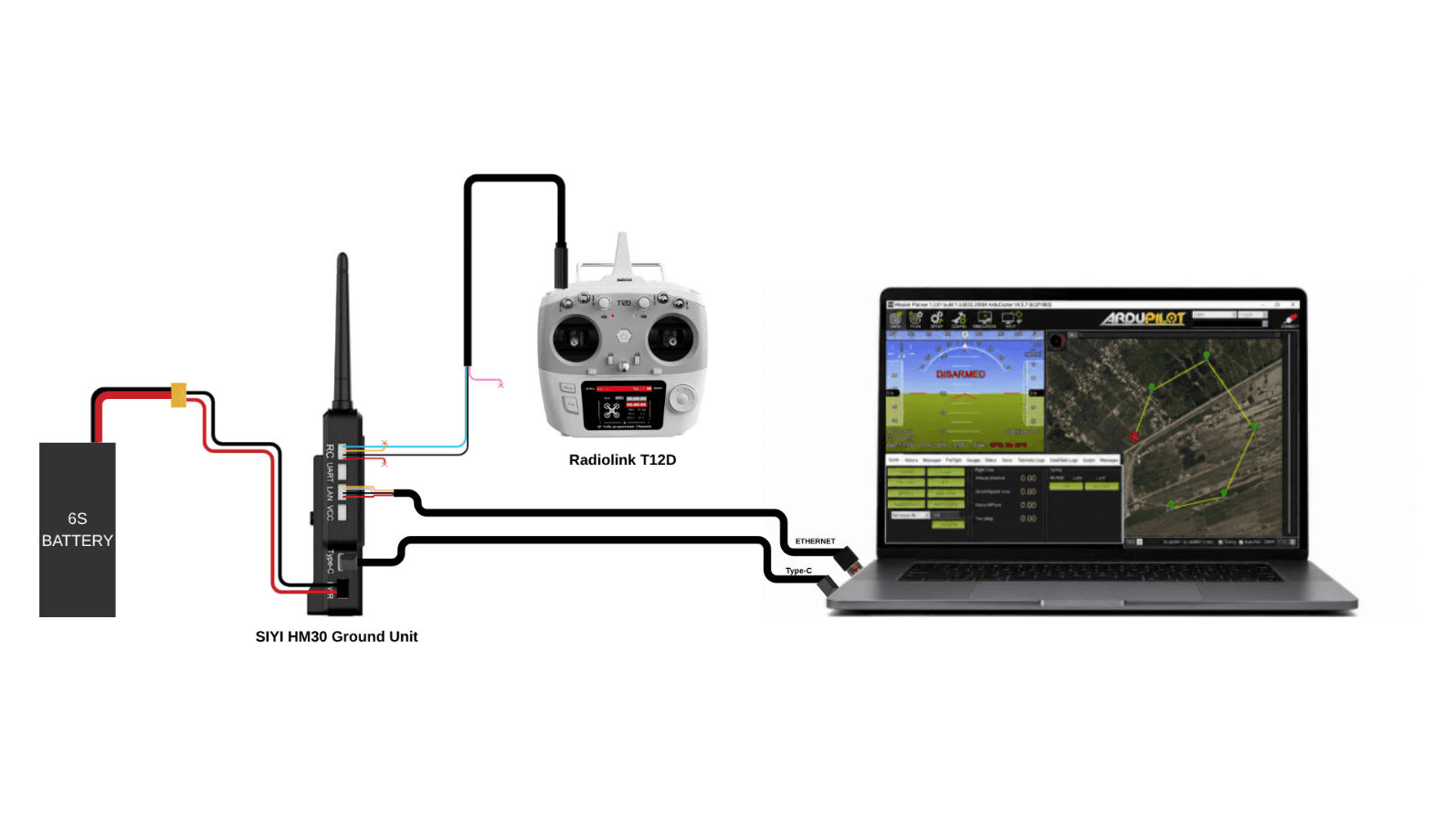
Figure 1. The ground segment as cabled. The HM30 Ground Unit runs from a 6S battery, the Radiolink T12D is wired into its RC port, and two separate cables run into the GCS laptop: USB for telemetry into Mission Planner, marked Type-C on the diagram, and Ethernet for video. Note that no single cable carries both streams.
2.3 Range profile and safety-pilot override
A Radiolink T12D transmitter is part of the ground setup, for safety pilot operations and manual override; Figure 1 shows it wired into the RC port of the ground unit. Both the air and the ground unit carry high-efficiency omnidirectional antennas, chosen to hold the link across the competition's expansive flight boundaries.
The HM30 firmware is set to its 34 km FPV range profile even though the physical mission radius is relatively short. The intent is signal penetration and link stability, particularly during aggressive banking maneuvers and when the aircraft is hovering at lower altitudes during the payload delivery sequence. 34 km is a firmware setting and not a demonstrated range; no range test result is reported in this document.
3 Onboard avionics
The onboard data and control network is built on a two-computer split. The Orange Cube Plus handles real-time flight dynamics; the NVIDIA Jetson Orin NX runs the AI and computer vision workload.
3.1 Flight controller and mission computer
MAVLink telemetry between the two computers runs over a direct wired connection: the Jetson Orin NX plugs into the Orange Cube Plus micro USB port, which the autopilot presents as Serial 0. A physical serial link keeps latency low on the path that carries autonomous flight commands.
3.2 Camera feed distribution
The SIYI A8 Mini gimbal camera has one Ethernet output, and the feed is needed in two places at the same time: onboard for target detection and on the ground for the operator. A SwitchBlox Ethernet switch splits it. The same IP video stream goes to the Jetson Orin NX for real-time ODCL inference and to the SIYI HM30 Air Unit for the downlink to the GCS, so one camera serves both uses.
4 Propulsion and power
The aircraft weighs 6.7 kg fully loaded. Propulsion and power are sized around that number and around the autonomous maneuvering the mission requires.
4.1 Powertrain
Thrust comes from four T-Motor U7 V2.0 brushless outrunners at 490 KV, driven through a centralized RTF 80A 4-in-1 ESC. The powertrain is sized to leave thrust margin at 6.7 kg so that the aircraft keeps attitude authority in crosswind during the payload delivery phase.
4.2 Power distribution and regulation
There is no conventional power distribution board in the avionics bay. It was left out to maximize reliability and to keep its dead weight off the aircraft, which is the same weight argument that produced the single-datalink decision in Section 2. The cost is that every rail then has to be routed and justified individually, and that is what Figure 2 documents.
Power comes from a custom 6S array: six 2S 13000 mAh packs wired three in series and two in parallel. The high-voltage lines feed the 4-in-1 ESC directly. Dedicated step-down BECs supply regulated voltage to the avionics and to the MC33886 H-bridge driver. The SG90 servo that operates the payload release lock draws its power from the Jetson Orin NX rather than from a BEC of its own.
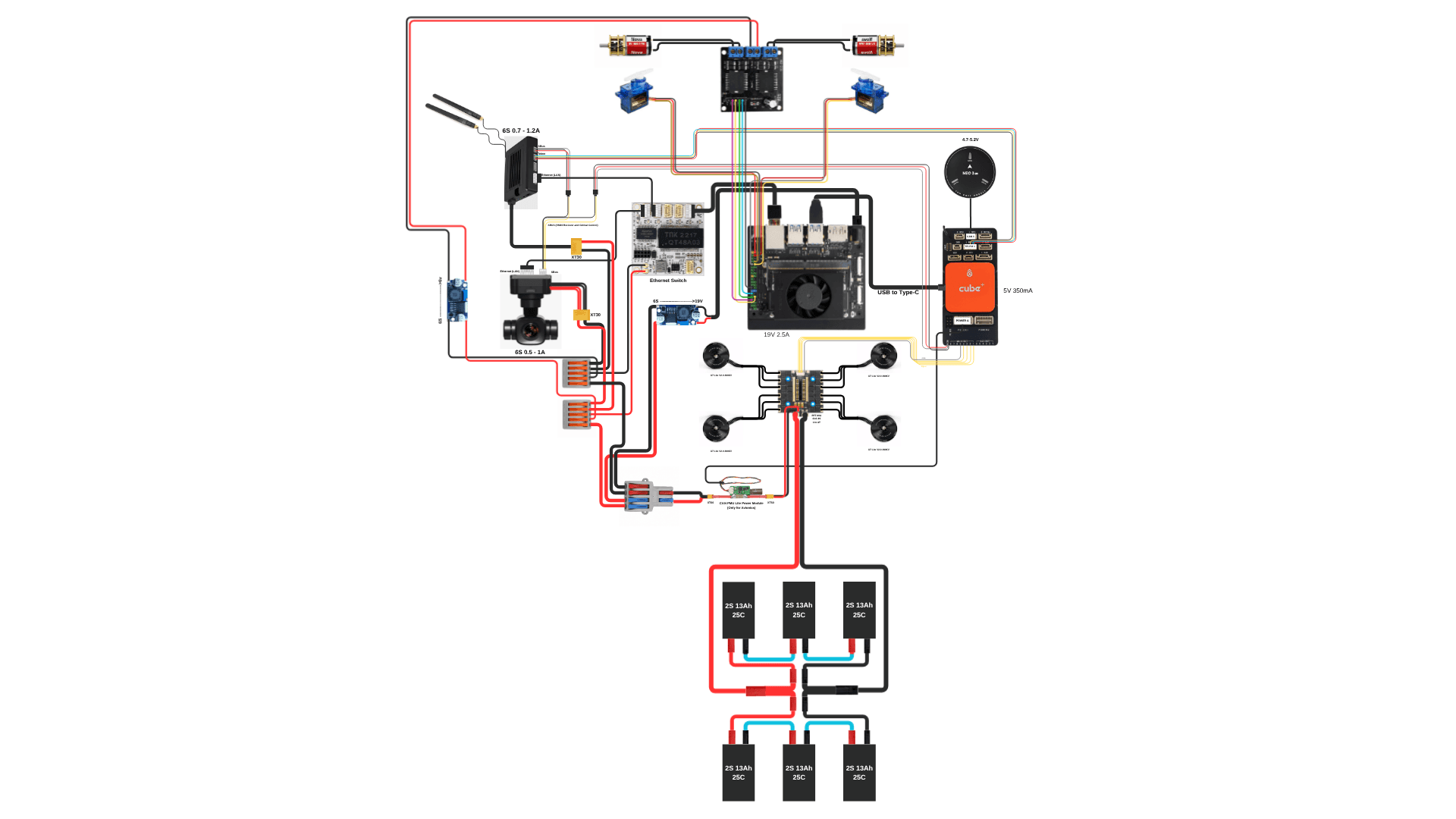
Figure 2. The complete power and data tree. Trace the six 2S packs at the bottom up through the 3-series, 2-parallel junction: the heavy pair runs straight to the 4-in-1 ESC while every avionics load hangs off its own step-down converter. Only a few branches carry a voltage and current annotation, and those are legible only at full resolution.